
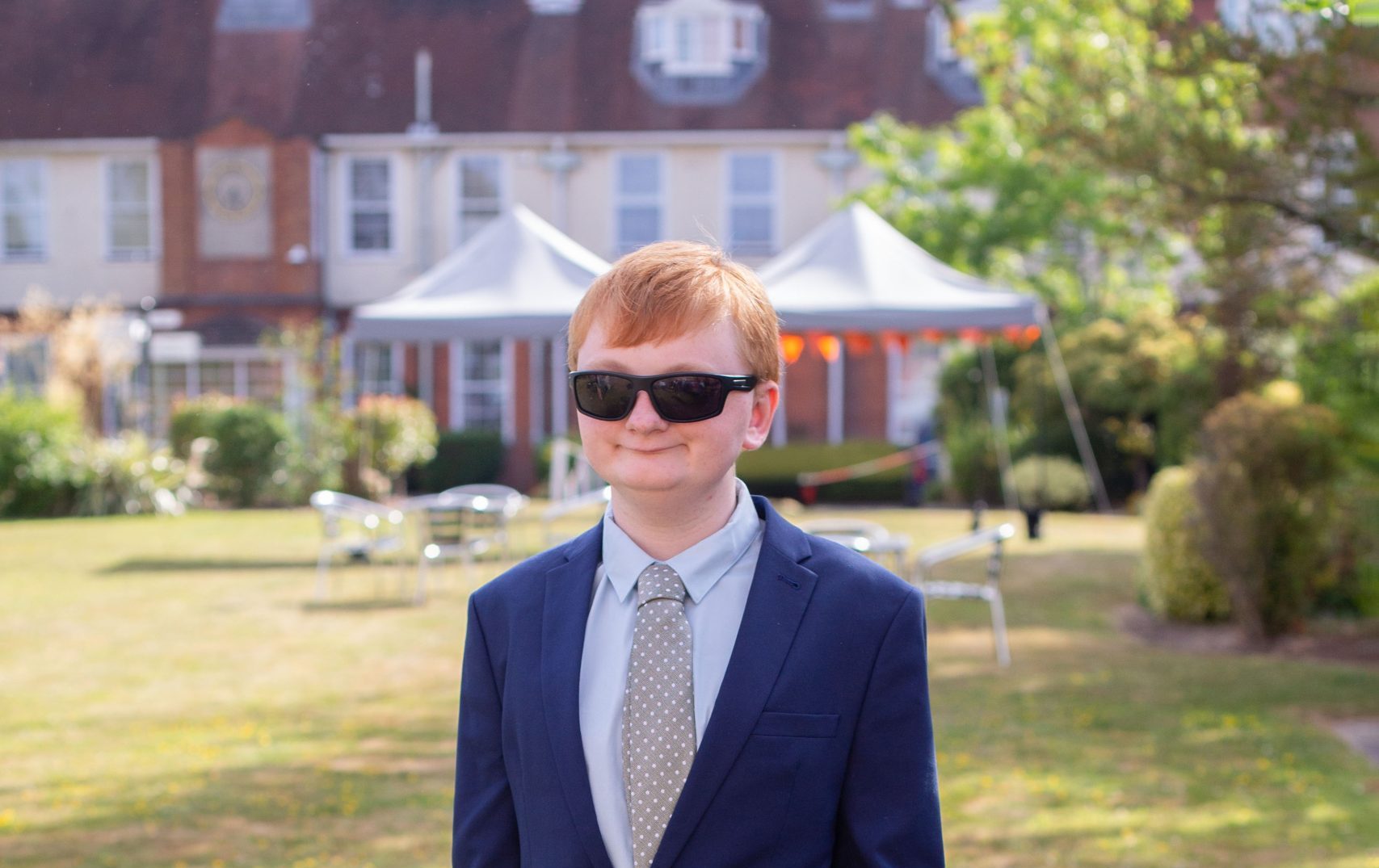
At NCW we aim to provide a well-rounded experience for our students during their time here, not just through our education but through things like learning to live independently and preparing for the workplace.
We are acutely aware of the challenges the visually impaired community faces when leaving education, with only one in four (27%) of working age adults in employment. This compares to an employment rate of 75% for the overall adult workforce. We know the placements we help to provide our students, alongside the other key skills they learn, help to boost confidence levels and readiness for the workplace.
We hear from Finley who has taken up a number of placement opportunities during his time here, and as a result now has a really clear sense of what he wants to do after leaving NCW.
Finley finds his calling in IT
Finley is originally from Monmouthshire in South Wales and was offered a place at NCW in 2018. Despite being given support at primary school, including a dedicated mobility officer and Perkins Brailler, Finley says the resources were limited. One area where this was particularly evident was the IT to which he was given access, which he said completely changed when he joined NCW. It was this experience that would prove to have a lasting effect on Finley’s life aspirations.
“For me personally, the exposure I’ve had to IT at NCW has made the biggest difference to my life,” says Finley. “Back in 2018, I had no real knowledge or understanding of IT and now, when I look back at my time here as I prepare to leave, I’ve had the chance to work with three IT companies, and even got the chance to teach IT to other students.”
Finley claims the work placements that NCW arranged for him were pivotal to knowing what he wants to do after leaving education.
“Over the last year alone I’ve got to do lots of work experience, giving me a range of skills but also crucially the ability to work alongside sighted people,” says Finley. “When you go out into the workplace, you need to know how to work alongside people who are sighted. For a blind person, that can feel really difficult and daunting, but thanks to these work placements, that’s no longer an issue for me.”
Learning to work independently
Finley’s first work placement was with a company called Spinify, whose main software product is a cloud based platform designed to help businesses streamline their operations. Later on he was given an opportunity to work with Dolphin Computer Access, a software development company who design and develop assisted technology for vision impaired people.
Finley says his time at these companies have helped him to become more independent, mainly due to the nature of the work he did for them.
“Being able to work independently was something I wouldn’t have been able to envisage a few years ago. But now I can,” he says proudly. “The idea of doing something by myself would have scared me before if I’m honest, but thanks to my work experience that’s not there anymore. As a blind person, it’s really freeing that I don’t have to rely on others as much as I did before.”
Finley leaves NCW ready to take on his next challenge
Finley is in no doubt about the impact his education and work placements have had on his life, with his confidence clear to hear. “My knowledge of IT was non-existent before my time at NCW, but thanks to my teachers and my work experience, they’ve helped me to learn IT to a point where I can comfortably walk into any workplace and go, ‘Look, I can use this!’, which is a great feeling.”
Finley is also clear that with the rapidly improving assisted technology available today, there should be fewer barriers for employers now. “I am fortunate to have had some really good experiences, and so I’ve seen the difference employers can make to a worker who is visually impaired. Alongside having the right IT in place, one of the main bits of advice I’d give someone is to make the task really clear for a visually impaired person to understand. And to let them know that if they have questions, they can ask them. Some of the actions that employers can take are really quite simple.”

