We know firsthand that providing specialist, tailored support for blind and visually impaired young people can make all the difference later in life. In the UK only one in four (27%) are in employment compared to the overall UK employment rate of 75% (ONS). Yet at NCW, 90% of our graduates go into further or higher education or employment after leaving us.
This is the story of Zoe Dixon who talked to us about her time at NCW, being taught self advocacy skills, and how this set her up for life outside the college, from her time at the University of Oxford to securing a job at KPMG, one of the UK’s ‘Big Four’ financial services companies.
Zoe’s story
Zoe’s NCW journey began in 2011 after previously attending a local mainstream primary school in Derby, which had a specialist unit for visually impaired children attached to it.
When asked what made such a positive difference during her time at NCW, Zoe immediately highlighted the role that her teachers played, who she says really understood the needs of visually impaired students.
“I can’t stress enough the importance of being taught by teachers who understand visually impaired students, what we are capable of, what we might need additional help with, and how we might be able to build our skills so that we can cope with more,” says Zoe.
Zoe also points to the importance of having all her curriculum materials in an accessible format for visually impaired students.
“I’ve since heard horror stories of students in mainstream education settings who are not getting worksheets in formats that they can do, who end up weeks behind everyone else in the classroom,” says Zoe.
However, what really set NCW apart, Zoe says, was the positive and powerful mindset that she and her peers were taught, which she says is epitomised by Dr Normanton-Erry, Head of History and Politics and Head of Outreach at NCW, in her research paper ‘They can because they think they can’.
“This kind of approach has had such a positive impact on us all,” says Zoe. “It ends up putting students in the mindset where, actually, as far as possible, we’re not putting barriers in our way because we think we can’t do something. The result is that we end up being taught how to build our skills that we can cope with more, not less, which is really empowering.”
Preparation for university and the workplace
It was these self advocacy skills that would go on to have a lasting impact on Zoe when she went on to university and then securing her first job. Zoe also feels that NCW got it right when it came to balancing the need for specialist support, while encouraging students to self-advocate and do things themselves.
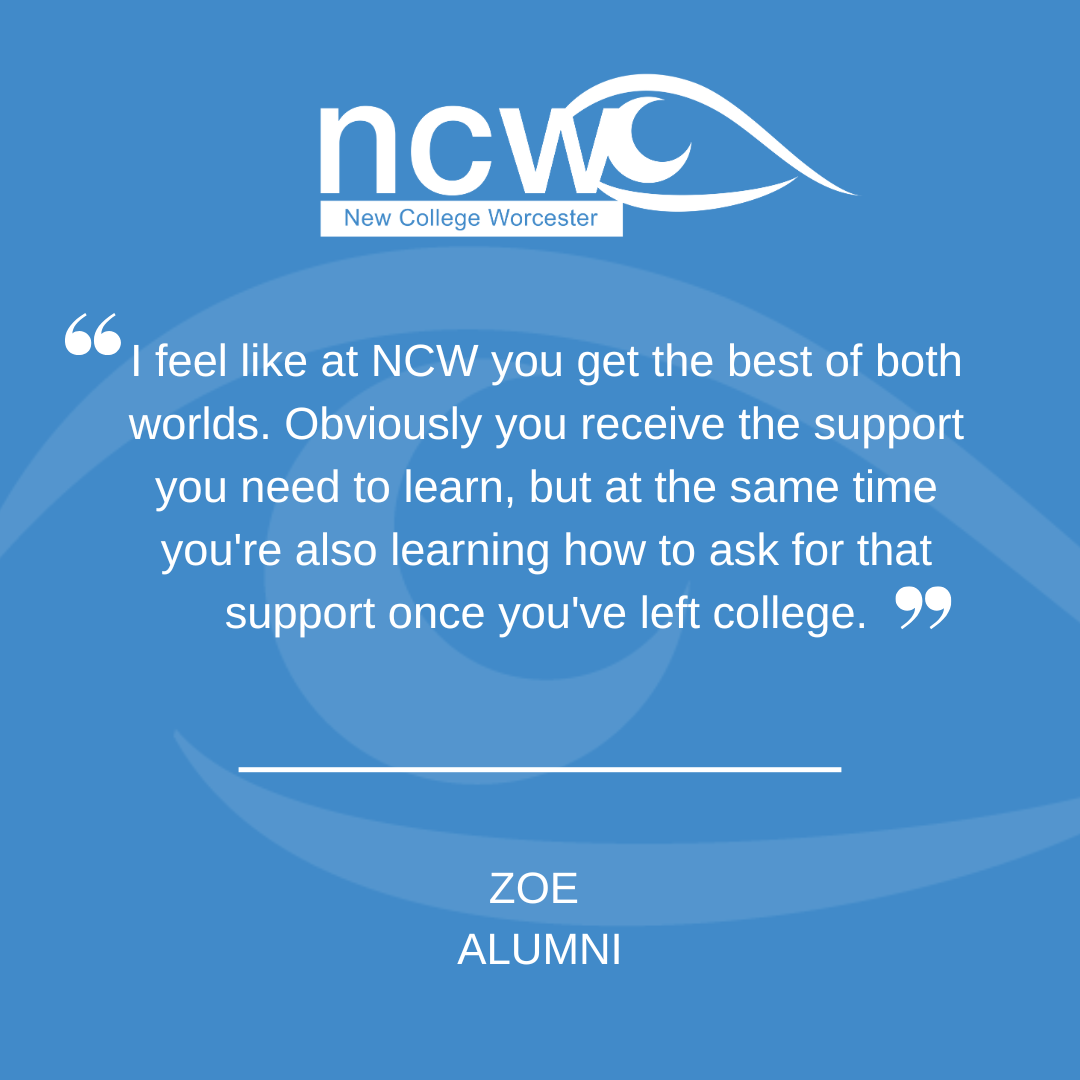
Zoe says: “I feel like at NCW you kind of get the best of both worlds. Obviously you receive the support you need to learn, but at the same time you’re also learning how to ask for that support once you’ve left college. This is particularly important because people might not be looking out for what you might need as much as in a specialist environment like NCW.”
Zoe goes on to say that this first made a big difference when she got to university: “When I had additional access requirements, I had to be the one to initiate the process, such as asking the university library to provide the books I needed in an accessible format”.
It would also prove to play an important role in the workplace. After Zoe graduated from the University of Oxford, she quickly secured a job at KPMG, where she now works in the tax department. And although she hails her employer as ‘one of the best’ for disability inclusion, she knows from speaking to others in the VI community that this isn’t always the case.
“In a lot of workplaces you have to be ready to be able to communicate exactly what you need, when, and which team needs to take that action. Thankfully this is something that we’re all taught so powerfully at NCW.”
Call for more support
Zoe’s story is proof of what someone can achieve when a young person receives timely and tailored support at school. It’s one of the reasons why we recently teamed up with other special educational needs schools to write to the government and urge them to do more to help visually impaired young people transition from education to employment.
As NCW assistant principal Victoria says: “Our young people are phenomenal. They have great memories, they’re sharp, they problem solve, they can multitask way better than many of us could ever dream of doing. These are precisely the people you would want to have in the workplace.”
