We want to do all we can to empower our students to find employment or further education opportunities once they leave us. We know that our students face significant barriers in the workplace, with only one in four (27%) of vision impaired working age adults in employment, compared to the overall UK employment rate of 75% (ONS).
We are proud of the fact that 90% of our graduates go into further or higher education or employment after leaving New College Worcester (NCW), and one of the reasons behind this is the partnership work we do with employers to provide employment opportunities for our students.
One of those employers is Dolphin Computer Access, a software development company in Worcester who design and develop assistive technology for vision impaired people.
Long standing partnership with NCW
Dolphin was founded nearly 40 years ago in 1986 and started life providing screen reading and screen magnification. The company has grown, with a global presence employing 36 people, including 28 based in Worcester. Dolphin offers products including SuperNova – an advanced screen magnifier and screen reader for Windows computers; GuideConnect – an easy-to-use screen reading and magnification software; and EasyReader, an app for vision impaired readers that connects to accessible libraries.
Rachel Willetts has been at Dolphin for 17 years, and was recently appointed chief executive of the innovative company. She says the long-standing relationship with NCW has been in place even longer than that, and continues to provide interesting and beneficial work placements for students.
“Because of our background and our knowledge, we’re in a good position to offer meaningful placements for NCW students,” says Rachel. “We essentially offer two employment opportunities. One where students get experience across the business including marketing, sales and our helpdesk, and a longer-term placement, focusing on software testing and market research. These placements can be in-office or remote and are designed to be fully accessible and inclusive.”
Advice to organisations on employing vision impaired workers
Rachel agrees that the gap between employment rates for vision impaired people and their sighted peers is far too big. She believes that simply having an open conversation at the beginning, and a willingness to learn, has a hugely positive impact in the long-run.
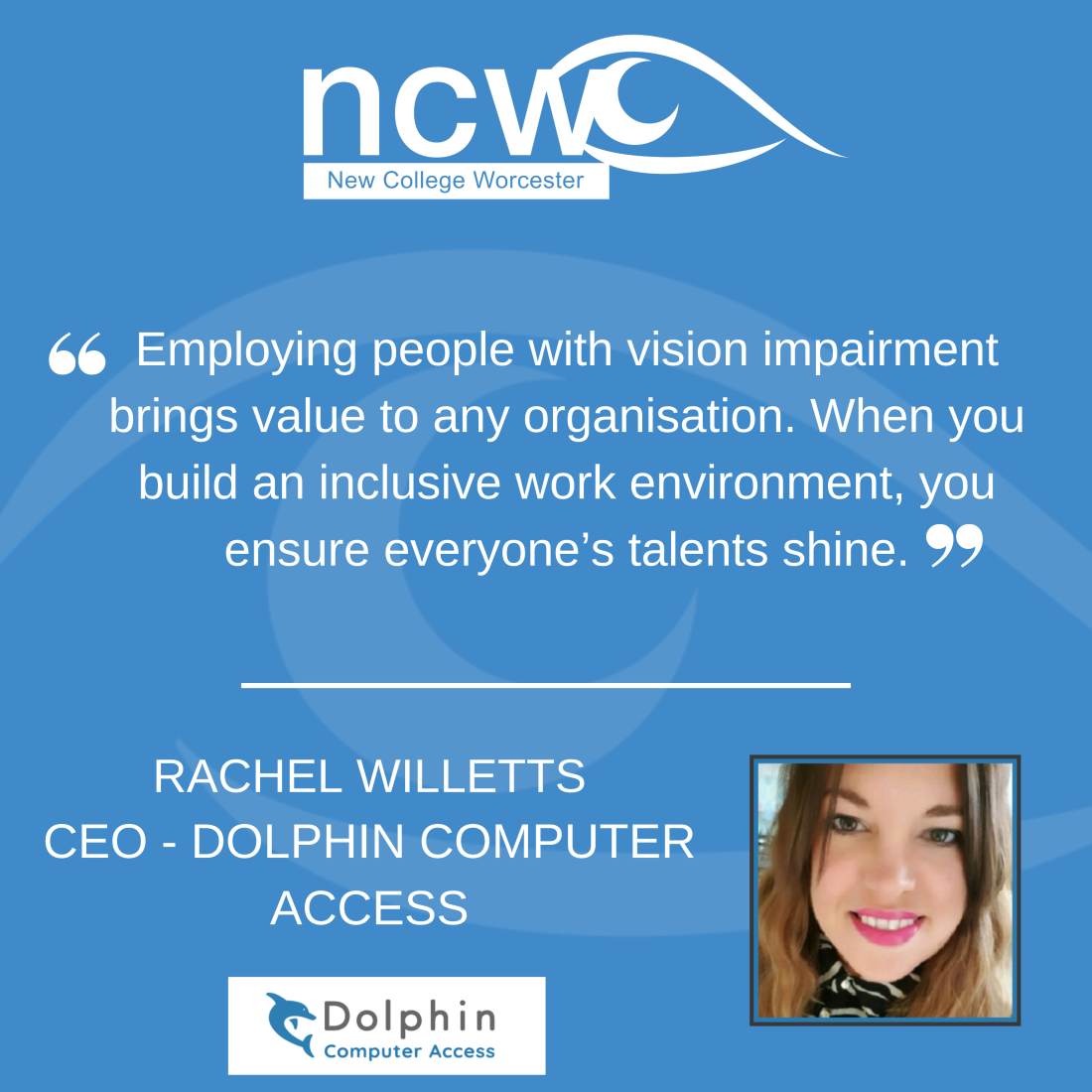
“Employing people with vision impairment brings value to any organisation. When you build an inclusive work environment, you ensure everyone’s talents shine,” says Rachel.
“Rather than making assumptions though, I would encourage employers to simply ask visually impaired employees about their specific needs and support requirements. The availability of assistive technology and a move to more remote working opportunities, means there should actually be very few employment barriers for visually impaired people.”
Rachel also points to funding and resources available for employing visually impaired workers, such as government schemes and those provided by the Royal National Institute of Blind People (RNIB).
“I really believe that employers are in a much better place to employ visually impaired workers compared to five years ago. The problem is that much more needs to be done to raise awareness of this.
“Above all, I’d say never ever underestimate the capabilities of a vision impaired employee. They have exceptional skills that could make a big difference to your workforce.”
“Young people are more confident than you think – especially when they receive the right support at school and college – which we’ve seen first-hand with NCW. Not only that, but our staff have often commented positively on the mentoring and support that they are able to give young people. All of this is good for personal and professional development, and good for employee satisfaction. I think the potential benefits for everyone involved are huge.”
Potential for a bright future for visually impaired workforce
Rachel believes that the landscape has shifted massively in favour of visually impaired employees in the 17 years that she’s been at Dolphin and that raising awareness among employers is still critical if we are going to bridge the gap in employment rates.
“Supporting students and other blind individuals in the workplace is actually quite simple in my opinion. Collectively, we need to raise awareness of the support and guidance out there for employers and work together to tackle some of the myths about employing a visually impaired person,” says Rachel.
Putting the right assistive technology in place empowers businesses to confidently hire blind professionals, ensuring they can excel in their chosen careers.
“I was fortunate enough to be at New College Worcester in February [2025] for the visit by Jacqui Smith, the skills minister and government spokesperson for equalities. I think it was important for the minister to hear from students and employers like me, to see just how capable, competent and hard-working vision impaired students are.”
